


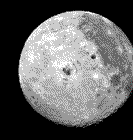
 You can see the Moon! Galileo saw its mountains and craters in 1609. Click to close.
 < Lobby


SOURCES
- Planet photos: NASA/JPL, from the 1996 Welcome to the Planets site. Sun: NASA/SDO. Pluto: NASA/JHUAPL/SwRI (2015).
- Facts: NASA Planetary Fact Sheet and NASA's moon pages, October 2026.
- Windows: 98.css (MIT), with the MS Sans Serif font by lou (CC BY-SA 3.0).
- Robot: Moby from BrainPOP, image from the BrainPOP Wiki.
Traveling to the Sun...
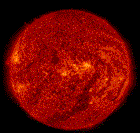
SUN
The Sun is a star, a huge ball of hot glowing gas at the center of our solar system. It is so big that about 1.3 million Earths could fit inside it. Its light takes about 8 minutes to reach us, and without it nothing on Earth could live.
Traveling to Mercury...
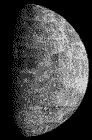
MERCURY
Mercury is the smallest planet and the closest one to the Sun. It has almost no air, so its days reach 800°F and its nights drop to -290°F. It zips around the Sun in just 88 Earth days, faster than any other planet.
Traveling to Venus...
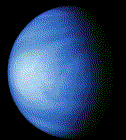
VENUS
Venus is the second planet from the Sun and almost the same size as Earth. Its thick clouds trap heat, making it the hottest planet at about 867°F. It spins backwards and so slowly that one day there is longer than its year.
Traveling to Earth...
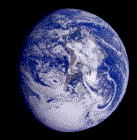
EARTH
Earth is the third planet from the Sun and the only place we know of with life. Oceans of liquid water cover about 70 percent of its surface. Its air protects us from the Sun's harmful rays and burns up small space rocks.
Traveling to the Moon...
MOON
The Moon is Earth's only natural satellite, and it goes around us about once a month. It has no air or weather, so astronaut footprints there can last for millions of years. Twelve astronauts walked on the Moon between 1969 and 1972.
Traveling to Mars...
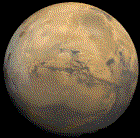
MARS
Mars is the fourth planet from the Sun and is called the Red Planet because of the rusty dust on its surface. It has the tallest volcano in the solar system, Olympus Mons, about two and a half times as tall as Mount Everest. Robot rovers are exploring Mars right now, looking for signs that it once had life.
Traveling to Jupiter...
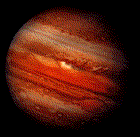
JUPITER
Jupiter is the biggest planet, so big that about 1,300 Earths could fit inside it. It is a gas giant made mostly of hydrogen and helium, with no solid ground to stand on. Its Great Red Spot is a storm wider than Earth that has been blowing for hundreds of years.
Traveling to Saturn...
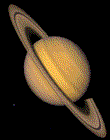
SATURN
Saturn is the sixth planet from the Sun and is famous for its bright rings. The rings are made of billions of pieces of ice and rock, some as small as sand and some as big as houses. Saturn is so light for its size that it would float in a giant bathtub of water.
Traveling to Uranus...
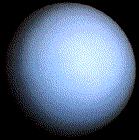
URANUS
Uranus is the seventh planet from the Sun and is an ice giant. It is tipped over on its side, so it rolls around the Sun like a ball. Methane gas in its air gives it a pale blue-green color.
Traveling to Neptune...
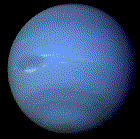
NEPTUNE
Neptune is the eighth planet and the farthest one from the Sun. It has the strongest winds in the solar system, faster than 1,200 miles per hour. One year on Neptune lasts 165 Earth years, so it has gone around the Sun only once since it was discovered in 1846.
Traveling to Pluto...
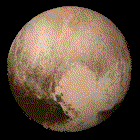
PLUTO
Pluto is a small, icy world far beyond Neptune. It was called the ninth planet until 2006, when scientists decided to call it a dwarf planet. In 2015 the New Horizons spacecraft flew past and found a giant heart-shaped plain of ice.
Traveling to the Solar System...


SOLAR SYSTEM

Thanks for visiting!
Come back soon.
Start over

Loading Planet-O-Rama...